Blogs
February 10, 2026
7
Mins Read
In my previous article, “From Systems to Platforms: Why Modern Logistics Can’t Survive on Traditional Architecture,” I argued that the logistics industry has outgrown traditional system-centric models. The proliferation of WMS, TMS, OMS, ERP, and point solutions has created fragmented execution, slow decision cycles and rising complexity. The conclusion was clear: modern logistics companies need platforms, not more systems.
This follow-up article explains the next logical question:
How does a modern logistics platform actually run in real time?
The answer is Event-Driven Architecture (EDA), the execution model that enables logistics platforms to sense and respond instantly to operational change.
If platforms solve the integration problem, EDA solves the execution problem.
Without EDA, a logistics platform is just a well-integrated stack of systems. With EDA, it becomes a real-time decision engine—capable of delivering the speed, resilience, and customer experience required in modern supply chains.
Picture a logistics operation from ten years ago. Orders came in batches. Warehouses processed them overnight. Trucks departed on fixed schedules. Reports arrived the next morning. It was predictable. It was manageable. And it worked, because customers expected it to work that way. That world no longer exists.
Today, a customer places an order at 10:47 AM and expects to track it by 10:48 AM. A driver hits unexpected traffic, and the system needs to reroute instantly, not after a supervisor reviews the delay report. A temperature sensor in a refrigerated truck detects a 2-degree variance, and someone needs to know now, not at end-of-shift.
Legacy logistics architectures were built for linear, predictable flows: receive, store, pick, pack, ship, deliver. But the real world no longer follows a straight line.
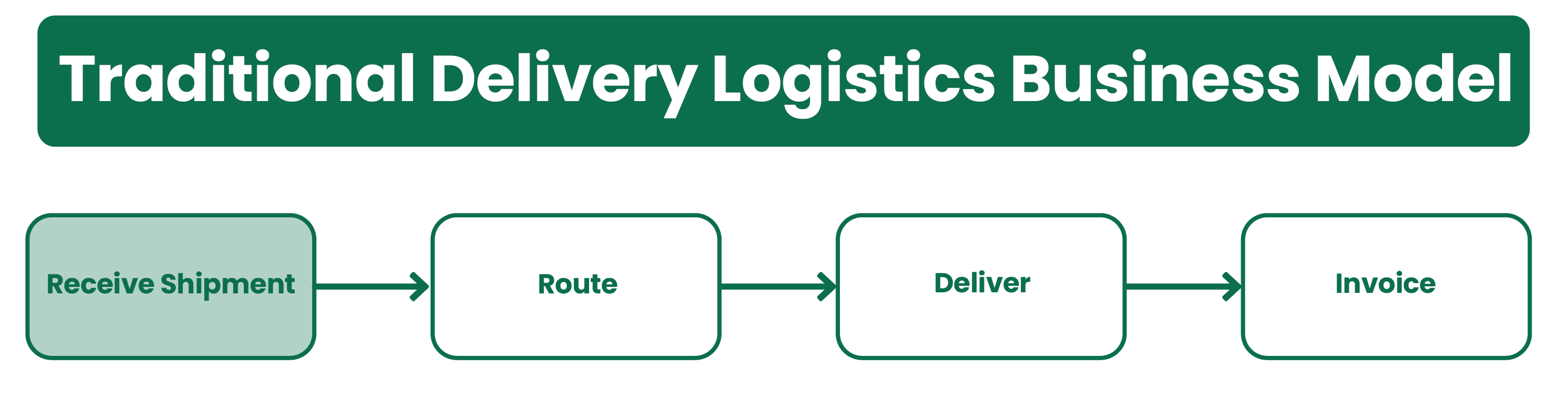
But the real world no longer works this way.
Meeting these expectations demands micro-fulfillment, parallelized workflows, and instant exception handling, capabilities that sit far beyond the design intent of most legacy systems. Brands outsourcing logistics now expect full process continuity. They want their SLAs, workflows, and decision logic to execute exactly as if done in-house. "We'll send you a report tomorrow" is no longer acceptable.
A decade ago, a logistics provider might have specialized in one thing: warehousing, or trucking, or last mile. Today, the same provider runs eCommerce fulfillment, B2B distribution, cold chain, last-mile delivery, cross-border shipping, and reverse logistics, each with unique workflows, data models, and customer requirements.
One system cannot do all of this. And stitching together ten systems creates a different problem: fragmentation.
Logistics execution is shaped by continuous, real-time decisions:
The "happy path" where everything goes according to plan is the exception, not the norm.
Only an architecture designed for branching decision logic can be kept up.
Not all delays are operational; most are informational. When operations fail, it is rarely because a system is broken. It’s because the organisation learns about critical events too late.
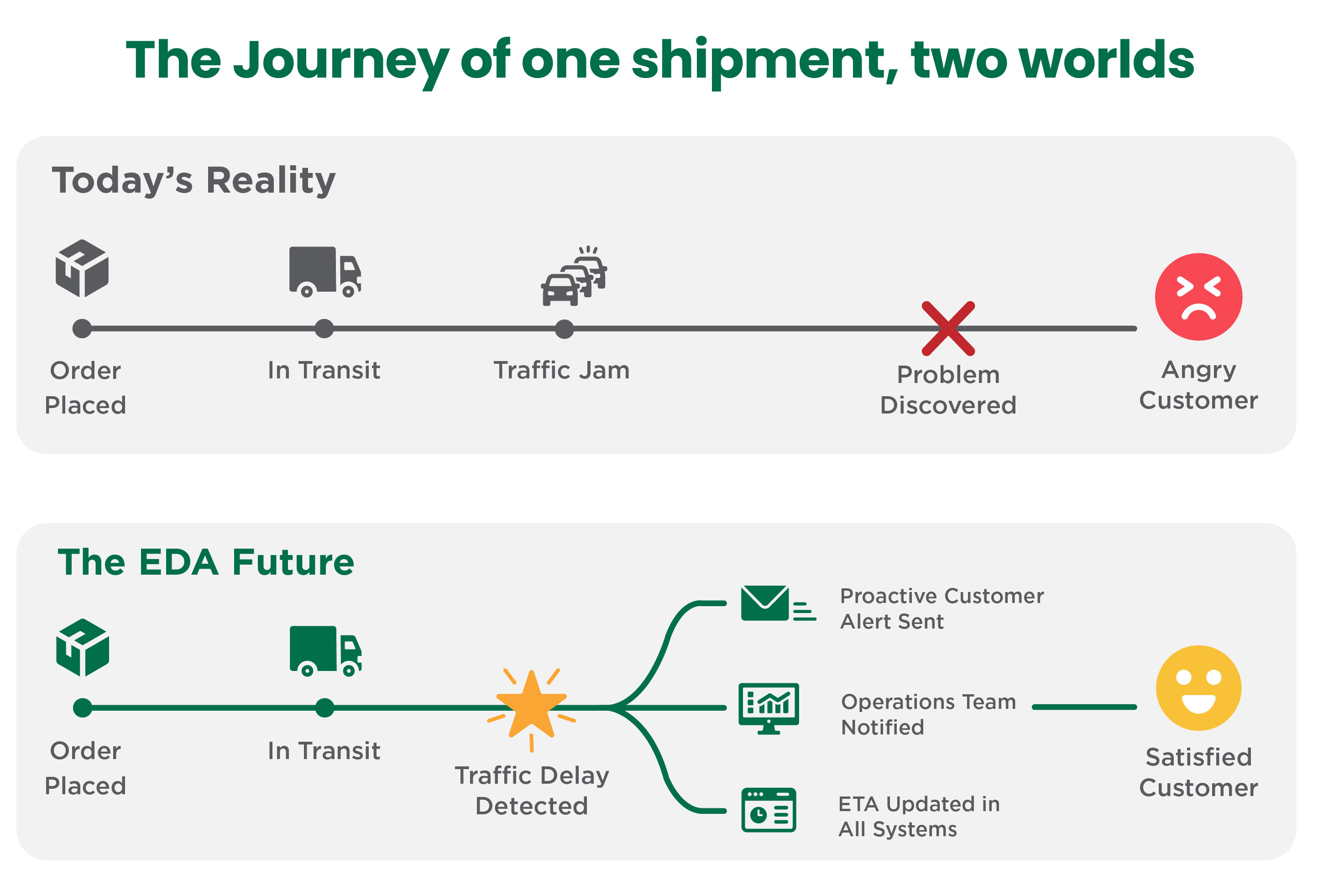
A driver is delayed → WMS or TMS updates late → team responds later → customer escalates.
This latency is caused by:
In a world where SLAs are measured in minutes, latency becomes the single largest operational risk.
EDA is the antidote to latency.
EDA is not about technology, it is about reacting to reality in real time.
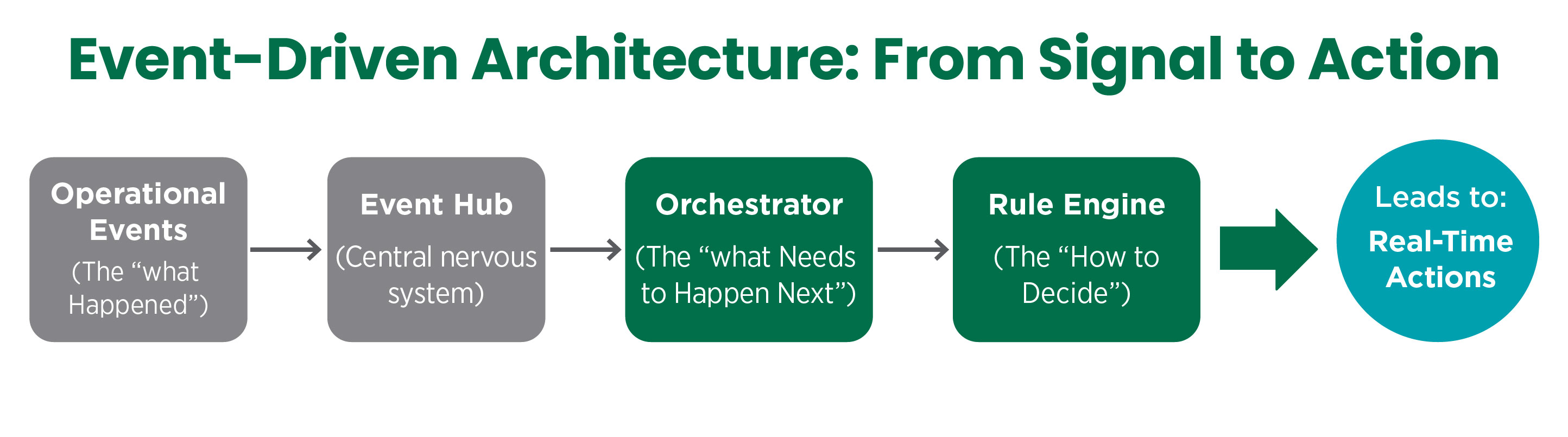
No batching. No waiting. No blind spots.
Creating a real-time, traceable stream of everything happening in the network.
It understands what should happen next: notify, reassign, escalate, replan, charge, etc.
SLA rules, SOPs, workflows, exceptions — all configurable without engineering.
Small, modular services perform tasks like ETA updates, order fulfilment, or routing decisions.
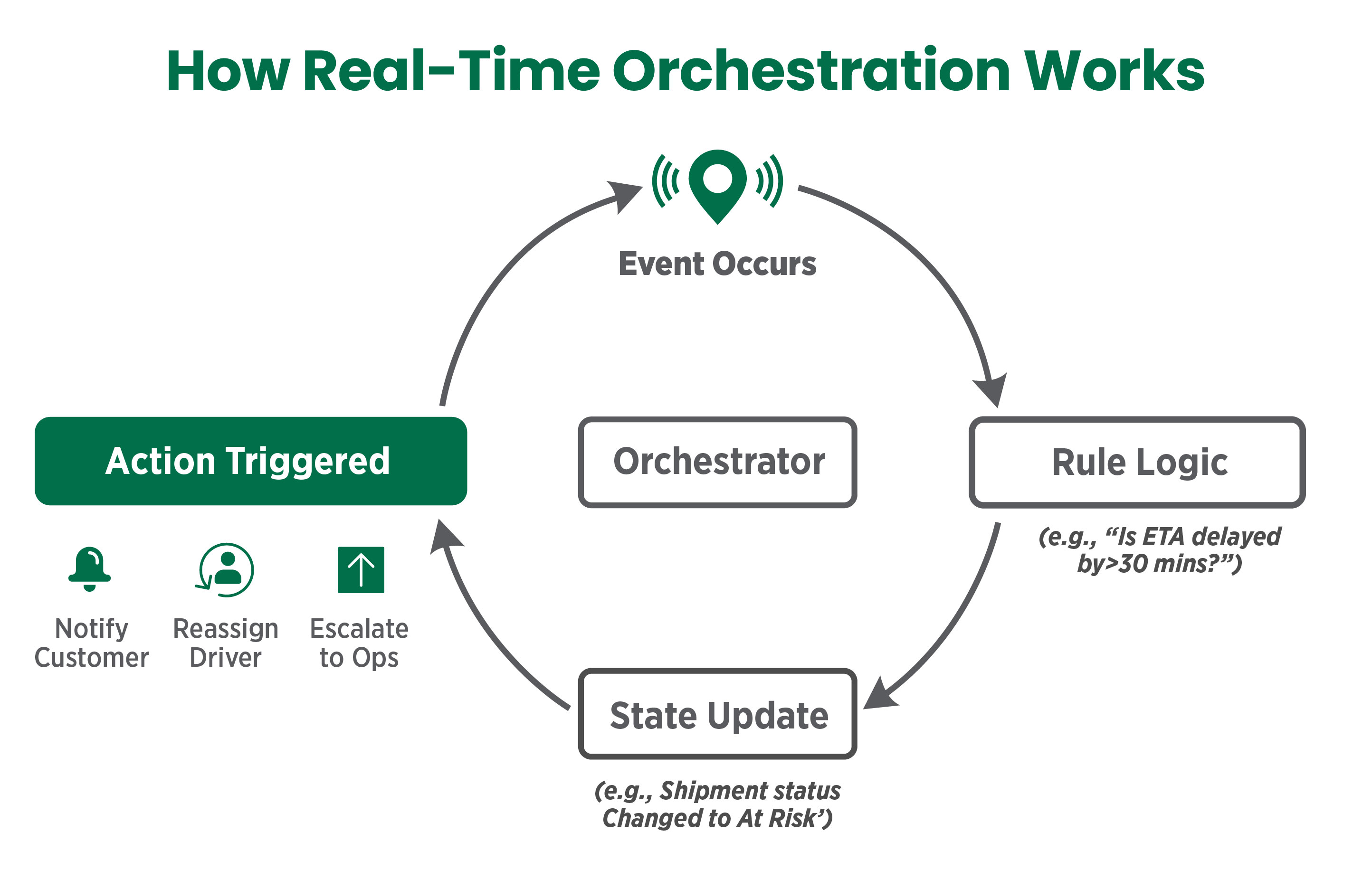
EDA converts logistics from system-driven workflows to event-triggered, real-time decisioning.
Based on our experience at Starlinks, EDA delivered value across five strategic dimensions:
Immediate reactions prevent cascading failures and missed SLAs.
Automating exception-heavy workflows reduces manual labour and improves margins.
Teams shift from status-checking to managing exceptions — where the real operational leverage lies.
Proactive notifications improve customer satisfaction and reduce escalations.
New business lines and product innovations become configuration tasks instead of integration projects.
A mature EDA platform includes six essential layers:
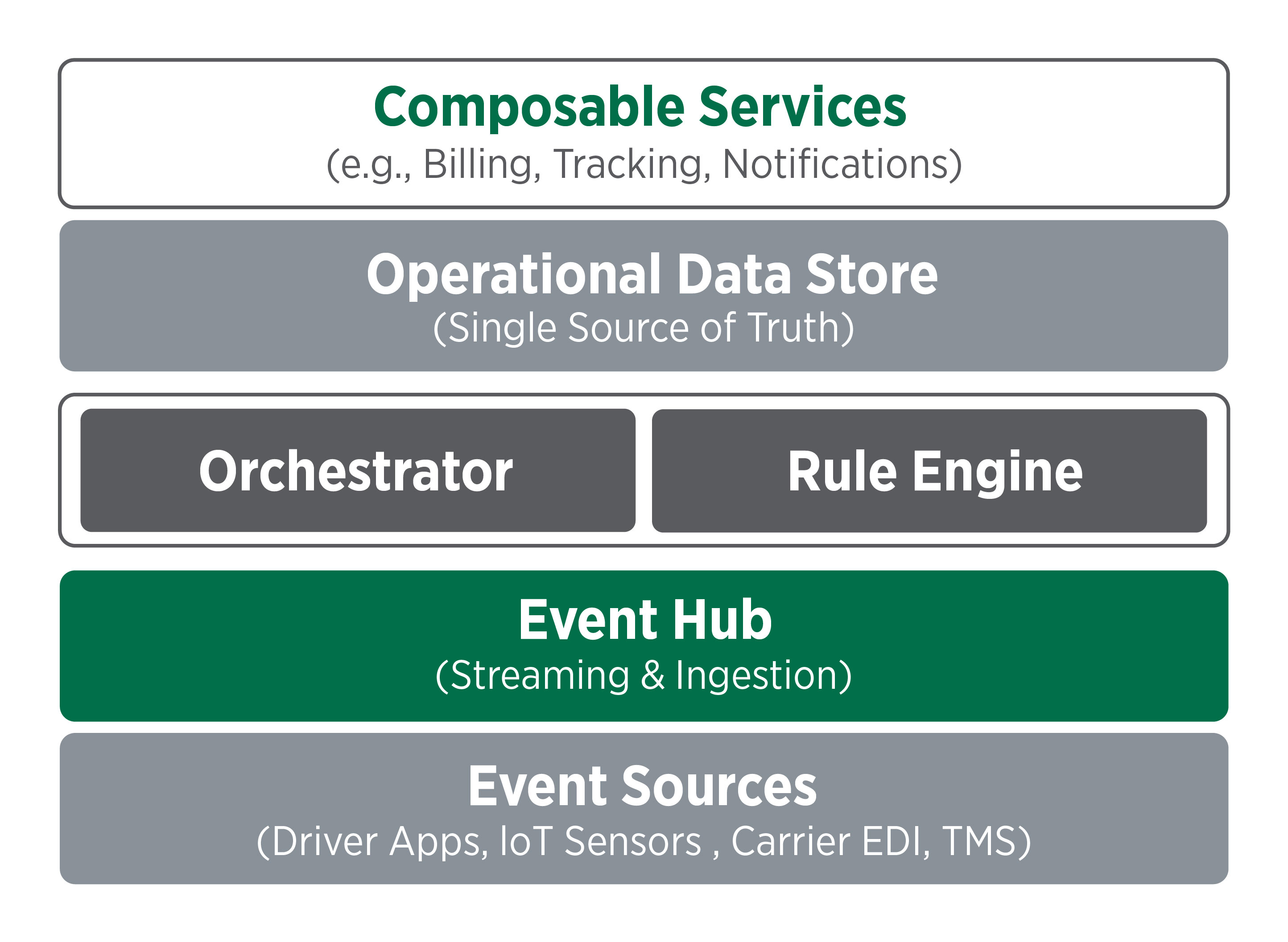
Composable services of WMS, TMS, OMS, ERP, IoT and marketplaces or carrier APIs emit operational events the moment they occur.
A structured, ordered, real-time event stream eliminates data drift.
Centralised logic determines which action follows which event.
Business teams maintain customer-specific SLAs and workflows.
All actions operate against a single, authoritative operational state — ensuring consistency, traceability, and correct decisions.
Small modular services execute operational tasks efficiently, creating outcome actions.
Examples:
EDA ensures that every event leads to a clear, immediate, automated operational outcome.
Instant ETA recalculation and customer notification prevent escalations.
Operational events and actual compliance for the SLA tiers drive financial milestones automatically.
Temperature deviations trigger immediate workflows — not end-of-shift surprises.
Event metadata supports customer-specific SLAs, SOPs, and workflows.
Failed scans, shortages, and damages — resolved without human intervention.
These use cases typically represent the majority of operational pain, which is why EDA produces such a rapid ROI.
The shift towards Event-Driven Real-Time Logistics Platforms is not theoretical. Global logistics and transport leaders are already running on event-driven foundations.
DHL Express: has modernized its integration architecture with Kafka-based data streaming to complement MQ/ESB and support real-time parcel and letter services.
Maersk publicly states it has adopted a reactive, event-driven architecture in its booking and pricing APIs, where core services emit events consumed by customer-facing microservices. (source)
Kuehne+Nagel uses a Kafka-centric event-driven architecture (KNITE) to synchronize data in real time across 200+ cloud applications for air and sea freight.
Hermes, a major German postal and logistics operator, runs one of the largest Kafka platforms in Europe to enable real-time visibility across its network. Their cloud-based, event-driven architecture allows operational data to be replicated quickly and securely, feeding Kafka streams that support real-time analytics and faster, more informed decisions throughout their logistics processes. (Source)
Swiss Post and Austrian Post both use Kafka — hosted on Microsoft Azure — as a core component of their parcel tracking system. By streaming data in real time, they have improved operational efficiency and gained much better visibility across their delivery network.
Shippeo, a global leader in real-time multimodal transport visibility for logistics providers, shippers, and carrier connects traditional databases (MySQL and PostgreSQL) and cloud data warehouses (Snowflake and BigQuery) with Apache Kafka and Debezium, enabling continuous, real-time data streaming. (Source)
Legacy systems can stay, which maximises ROI from the previous investments; they just need to emit clean events.
Operations teams must shift from “status checking” to “exception-led execution.”
This is where most cost, risk, and customer pain originate.
Event traceability is essential for orchestration.
Consistency and agility must coexist in clear platform governance policies.
SLAs, routes, SOPs evolve weekly — rule engines must keep up.
Teams must trust automated decisions before they rely on them.
Event-Driven Architecture transforms logistics from periodic, manual coordination into continuous awareness and autonomous action.
In an environment where every minute matters, this shift is decisive.
Companies that adopt EDA will operate faster, scale more effectively, and deliver more consistent service, not because their systems are better, but because their architecture finally reflects how logistics actually works.
EDA is not an IT upgrade: it is a new execution model for an industry defined by variability and real-time complexity.
EDA gives the platform real-time reflexes; composability gives it structural agility.
In the next article, I’ll outline the 7 Principles of Composable Logistics Platforms: loosely coupled services, multi-tenant design, a unified ingestion layer, and a rule engine that allows every customer’s workflow to run without custom development.