Blogs
November 23, 2025
6
Mins Read
 The News RoomBlogsFrom Systems to Platforms: Why Modern Logistics Can’t Survive on Traditional Architecture
Ten years ago, a logistics company could operate with a few core systems, a predictable flow, and a relatively linear process:
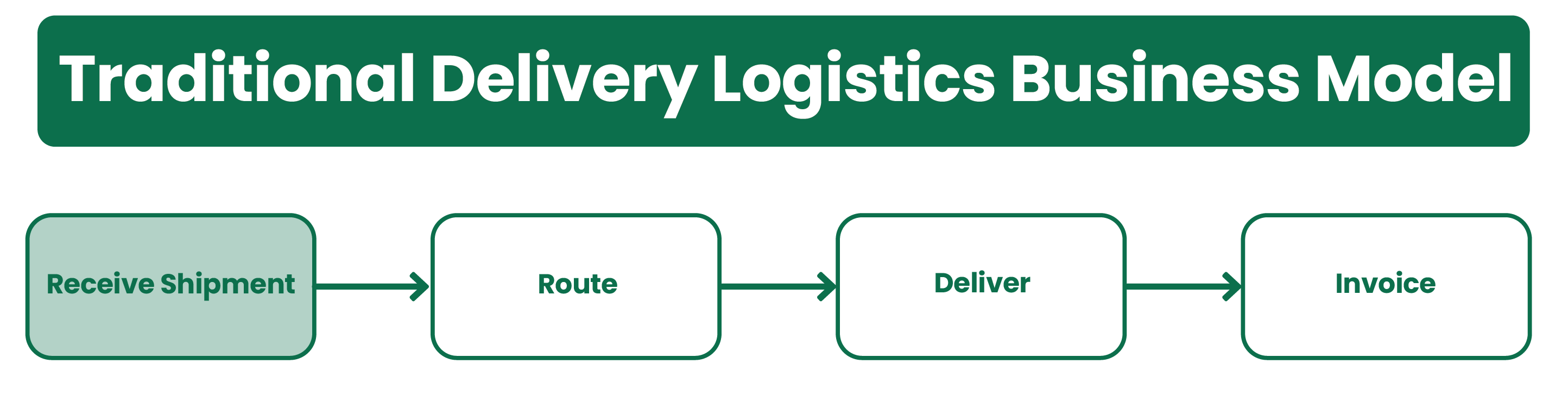
But that world is gone.
Today, logistics companies sit at the intersection of changing consumer expectations, evolving brand requirements, and exploding operational complexity. The traditional architecture consisting of monolithic systems, batch updates, siloed operations - simply cannot keep up with the speed and variability of modern supply chains.
Let me give you a snapshot of how the tech world of logistics has changed.
What used to be “next-day delivery” has become “15 minutes or less.” (see real world examples from Noon Minutes, Flipkart minutes, Blinkit, zepto, Big basket)
Such ambitious promises require Multiple micro-fulfilment centres, dark stores, and a fleet of fast drivers must operate in parallel.
Inventory accuracy must be perfect adapting to the location demand. Communication must be instant. Re-routing must happen automatically.
This isn’t a WMS problem or a TMS problem.
It’s an architecture problem.
Brands, merchants, and manufacturers are no longer accept the “black box” services, they need:
The old WISMO (“Where Is My Order”) queries make a way for
“Make your process feel like an extension of mine.”
Many logistics companies started their business around a single flow we discussed above: receive → route → deliver → invoice.
This is where the cracks start to appear.
One system cannot handle all of this.
And yet every vendor claims they can.
What used to be covered by a “simple OMS” suddenly requires:
Every new service introduces a new system.
Every new system introduces new complexity.
Every complexity introduces more failure points.
This is how logistics companies slowly drift from execution engines to systems integration nightmares.
Most transformation projects begin with an “ideal customer journey.”
It looks great on slides. It almost never happens in real life.
Logistics is not a flow.
It’s a network of decision:
Every one of these decisions is influenced by:
This isn’t a process.
This is a decision graph.
A real-time logistics execution network.
And no monolithic system was ever designed to handle that.
Software vendors have become experts in upselling:
All useful capabilities. None designed to work seamlessly together.
Instead of a cohesive foundation, companies end up buying:
Duplicated features → overlapping capabilities → rising TCO → disjointed user experience → inconsistent data.
Every system claims to be a platform. Very few are. And the cost isn’t only financial.
The real cost is operational complexity.
At Starlinks, we reached a stage where:
We realised we didn’t need more systems.
We needed a platform, a unified execution fabric that:
The question wasn’t: “Which vendor should we buy next?”
It was: “How should a logistics company operate in the next 10 years?”
The platform we built (and continue to evolve) is based on a few core principles:

Everything starts as an event.
No polling. No delays. No blind spots.
Logic lives in workflows, not in systems.
Each brand → its own SLAs, SOPs, logic.
Small, independent services triggered automatically.
Every event is stored; every event is traceable.
One platform → many business units → many customers.
One view of operations, not ten dashboards.
This architecture didn’t replace our WMS, TMS, OMS, or ERP.
It unified them.
Integration isn’t something you “finish”; it becomes a continuous discipline that must evolve as services, customers, and products change. Treat it like a capability, not a deliverable.
Buying more systems makes you more similar to competitors. Building your own orchestration, rules, and data fabric makes you meaningfully different. TCO explodes when features overlap
Customers expect your workflow to feel like an extension of theirs. Your tech stack must accommodate their logic, not force them into yours.
Every duplicated AI module, analytics layer, and workflow tool silently increases cost and complexity. Consolidate capabilities into the platform layer to control spend.
SLAs are measured in minutes, not hours. Batch processing creates latency, latency creates escalations, and escalations kill customer trust.
Logistics companies grow by adding services. If the tech foundation cannot support new business lines easily, growth becomes operational drag.
A single system can’t do fulfilment, linehaul, parcel delivery, billing, compliance, and customer visibility. But a platform can unify all these functions without replacing core systems.
The logistics companies that will win are not the ones with the best single system.
They are the ones with:
The future belongs to platform-native logistics companies, not system-centric ones.
This article is the start of a series where I will unpack:
And more importantly, I wanted to create a simple playbook on how others can follow a similar path while avoiding the mistakes we made along the way.