Blogs
June 28, 2026
8
Mins Read
For FMCG and retail brands operating in Saudi Arabia, distribution complexity grows fast. New cities, new retail channels, new product categories, and rising demand all add operational layers. The warehousing decisions made along the way shape how efficiently products flow through the distribution network.
As brands scale, one strategic question keeps coming up: should inventory and operations be spread across many smaller warehouses, or consolidated into fewer, strategically positioned hubs?
The shift toward centralized warehousing isn't about reducing presence. It's about positioning inventory where it actually serves demand. Done right, it transforms distribution from a fragmented operation into a connected, scalable system.
This article looks at what centralized warehousing actually means, how it reshapes FMCG and retail distribution in Saudi Arabia, and what to look for when evaluating a 3PL partner for centralized warehousing.
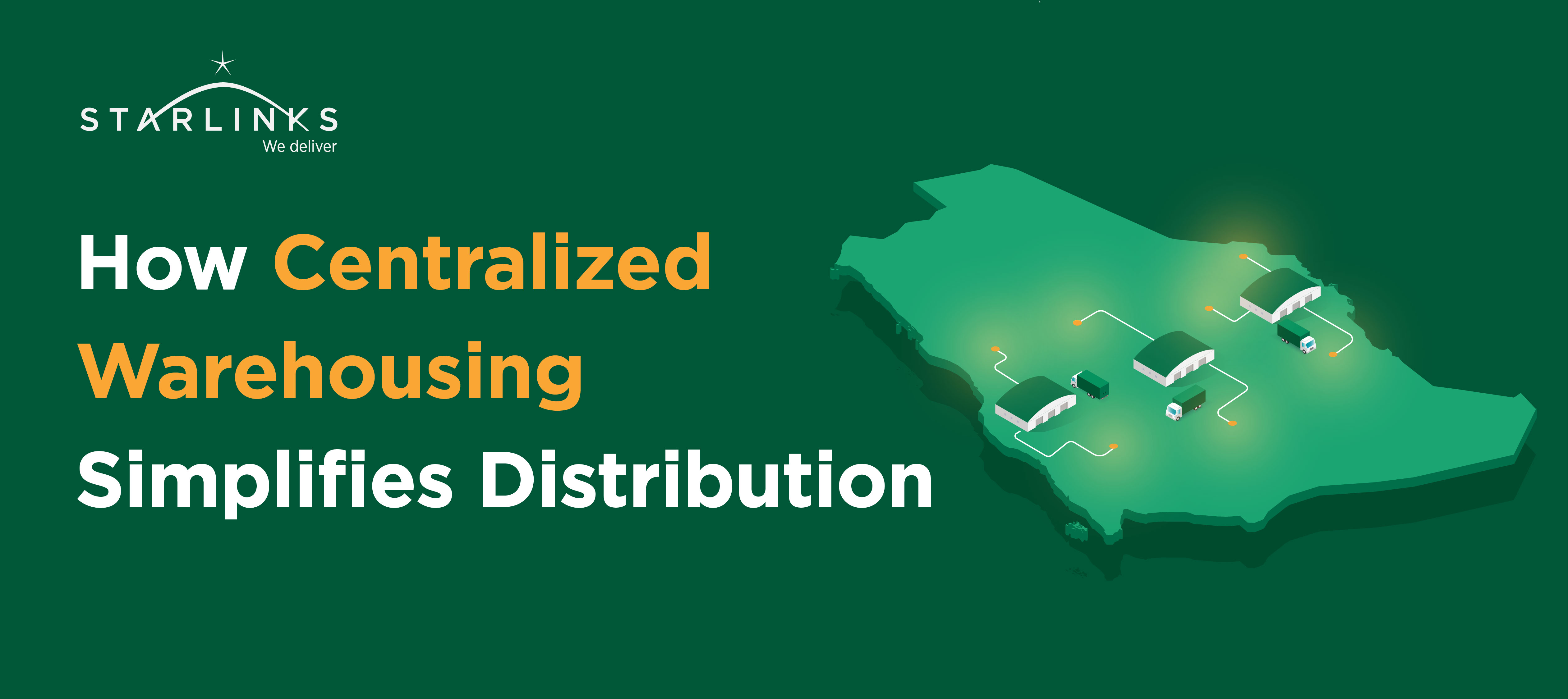
Centralized warehousing is the practice of consolidating inventory, receiving, storage, and dispatch operations into a small number of strategically located hubs, often through a 3PL partner, instead of maintaining many smaller warehouses spread across cities and regions.
The important clarification is this: centralized doesn't mean one warehouse for the entire country. It means strategically positioned hubs that cover the main demand centers efficiently, without the operational drag of running scattered facilities everywhere.
▪️Decentralized warehousing: many smaller warehouses spread across cities.
▪️Centralized warehousing: fewer hubs in strategic locations covering defined regions.
▪️Hybrid models: central hubs supported by smaller forward stocking points.
For most FMCG and retail brands operating nationally in Saudi Arabia, centralized warehousing strikes the right balance between operational efficiency and distribution reach. It reduces complexity without sacrificing coverage.
There's no universal warehousing network that fits every FMCG or retail brand. The right hub configuration, and the 3PL partner behind it, depends on the business itself, its product range, demand patterns, demand locations, and operational priorities.
What works for a national FMCG brand with high-velocity products across the Kingdom looks very different from a regional retailer serving only the central market, or an importer with concentrated demand near a major port.
▪️Demand geography: One region, several, or nationwide coverage.
▪️Product velocity: Fast-moving products often need hubs closer to demand.
▪️Seasonal demand cycles: Ramadan, Hajj, and promotional peaks shift regional demand.
▪️Channel mix: Modern trade, e-commerce, and quick commerce have different needs.
▪️Product type: Ambient, chilled, and frozen require different storage setups.
▪️Operational priorities: Speed, cost, capacity, and scalability vary by business.
For most nationally active FMCG and retail brands, the strategic hub locations naturally align with Saudi Arabia's main demand centers. The combination of population density, retail infrastructure, port access, and highway connectivity makes these cities the most efficient anchors for centralized warehousing.
▪️Riyadh: Saudi Arabia's largest consumer market with nationwide highway connectivity.
▪️Jeddah: Anchored to Jeddah Islamic Port, serving the western region and Hajj demand.
▪️Dammam: Anchored to King Abdulaziz Port, serving the Eastern Province and Gulf flows.
A brand might operate from one of these cities, two, or all three. For some businesses, the right central warehouse may sit outside the main cities entirely, positioned closer to specific production sources, regional demand, or industrial zones. The right warehousing network is the one that matches the business, not a fixed model.
Centralized warehousing doesn't just reduce the number of facilities. It simplifies the entire distribution operation, from inbound coordination through outbound delivery. With the right 3PL partner running the network, brands gain operational clarity, faster execution, and a single point of accountability across the supply chain. Here's how.
When inventory is pooled across fewer strategic hubs, brands get full visibility into stock levels, accurate availability data, and fewer duplicated safety stocks across multiple sites. Decisions are based on real-time data, not fragmented reports from scattered locations.
Fewer drop points mean simpler supplier coordination, fewer inbound errors, and more efficient receiving operations. Bulk inbound shipments are more cost-effective, and supplier relationships are easier to manage across a smaller number of nodes.
Hub-and-spoke distribution from strategically located hubs enables predictable, scalable outbound routing. Multi-drop deliveries optimize fleet utilization. Faster nationwide replenishment becomes possible because inventory is already in the right places.
Fewer warehouses with one 3PL partner mean fewer operational touchpoints to manage, fewer inventory locations to track, and fewer compliance points to oversee. Centralized operations develop deeper expertise, and quality and service standards become easier to maintain consistently across the network.
Concentrated capacity is easier to flex during Ramadan, Hajj, summer surges, and promotional cycles. Pre-positioned inventory at strategic hubs accelerates time-to-market when demand spikes. Decisions are made at the network level, not site by site..
This is what simplification actually looks like in distribution: not less work, but smarter, more connected work across the entire operation.
Not every centralized warehouse is built the same. For FMCG and retail brands, the difference between a basic warehouse and a strategic hub comes down to what it can actually deliver.
▪️Strategic location with direct access to highways, ports, and key demand centers.
▪️Substantial pallet capacity for daily operations and pre-season builds.
▪️Multi-temperature capability covering ambient, chilled, and frozen storage.
▪️High-throughput operations with parallel loading bays and 24/7 dispatch.
▪️Integrated transportation connecting the warehouse to nationwide distribution.
▪️Real-time visibility giving brands full control over inventory and dispatch.
▪️Compliance and certification including SFDA, food-grade, and audit-ready operations.
▪️Operational flexibility that scales with seasonal demand and growth.
The goal isn't to find the biggest warehouse available. It's to find the warehouse built around the realities of how FMCG and retail brands operate. That's where the right logistics partner becomes critical.
Centralized warehousing is only as good as the logistics partner behind it, and the network they operate. Strategic locations, integrated operations, multi-temperature capability, and real-time visibility are what separate a true competitive advantage from a simple cost-cutting exercise.
Starlinks operates exactly this network: strategically located, multi-hub, and built for centralized distribution at national scale.
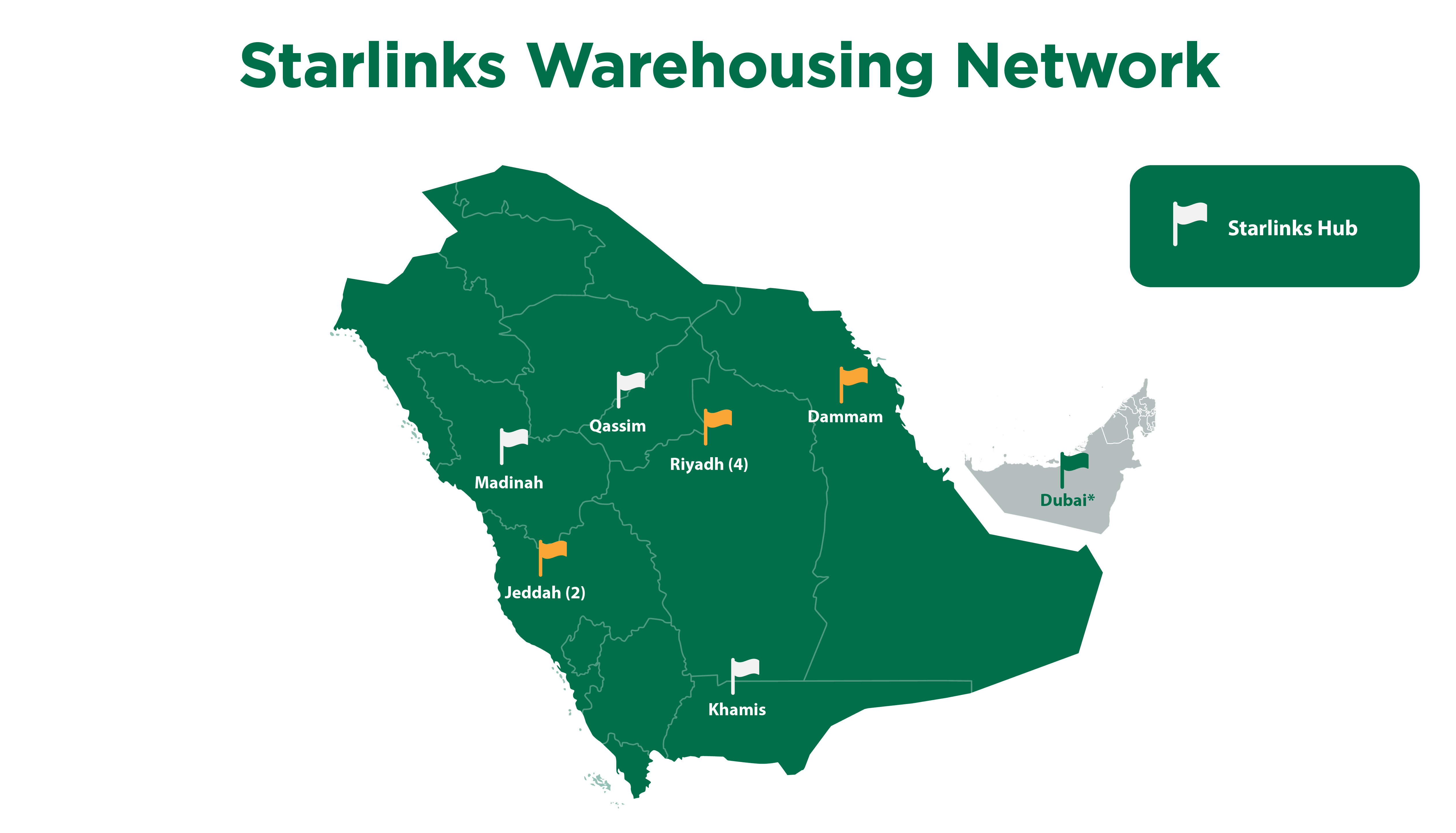
Starlinks' national network anchors centralized warehousing in the cities that matter most. Riyadh is home to two flagship facilities: Thuraya, the ambient logistics hub designed for high-velocity FMCG and retail movement, and Polaris, the dedicated multi-temperature cold chain facility. Jeddah and Dammam extend the network across the western and eastern regions, while additional facilities in Madinah, Qassim, Khamis Mushait, and Dubai broaden the footprint even further, putting inventory closer to demand across the Kingdom and into the GCC.
From ambient and chilled to frozen, Starlinks' network supports the full range of FMCG and retail product categories; across both warehousing and temperature-controlled transportation. Brands managing diverse portfolios can centralize their full SKU range with one logistics partner instead of fragmenting across multiple providers.
The Starlinks transportation network connects every hub to nationwide distribution. Hub-to-hub transfers, multi-drop delivery routes, and last-mile coverage are all part of the same integrated operation, eliminating the gaps that typically appear when warehousing and transportation are managed separately.
Real-time visibility into inventory, dispatch, and operational performance gives brands the data they need to manage their distribution with confidence. One source of truth replaces fragmented reporting across multiple sites.
The network is built to scale through Ramadan, Hajj, summer surges, and promotional cycles. Capacity flexes with demand, supporting pre-season builds without operational stress.
For FMCG and retail brands scaling across Saudi Arabia, this isn't just access to warehouse space. It's access to a centralized distribution network already built, ready to plug into, and designed around how the market actually operates.
Centralized warehousing simplifies distribution because it pulls a fragmented operation into one connected system. Inventory becomes a single source of truth instead of scattered reports. Inbound gets simpler, outbound gets faster, and demand peaks like Ramadan and Hajj become something you flex for, not scramble against. The footprint doesn't shrink, it gets sharper.
But that simplification only holds if the logistics partner behind it can carry it. Strategic hubs in the cities that matter. Ambient, chilled, and frozen across the whole network. Warehousing and transportation moving as one operation, with real-time visibility over all of it. That's the difference between a warehouse and a network built to distribute.
Starlinks already operates that network; anchored in Riyadh, Jeddah, and Dammam, with reach extending across the Kingdom and into Dubai. Not warehouse space to fill, but a centralized distribution network ready to plug into.