Blogs
March 18, 2026
7
Mins Read

In the first two articles of this series, I argued that modern logistics companies can no longer rely on traditional system-centric architectures, and that sustainable performance now depends on platforms powered by event-driven execution.
If Platforms solve the fragmentation problem, and EDA solves the real-time execution problem, then Composability solves the scalability problem.
Composable architecture determines how fast a logistics provider can:
- Onboard new customers
- Introduce new services
- Adapt to new SLAs
- Integrate partners
- Expand to new geographies
- Support business diversification
- Evolve without replatforming
This article introduces the 7 Principles of Composable Logistics Platforms, the architectural foundations that allow logistics technology to scale without the weight, rework, and technical debt that traditionally slow operators down.
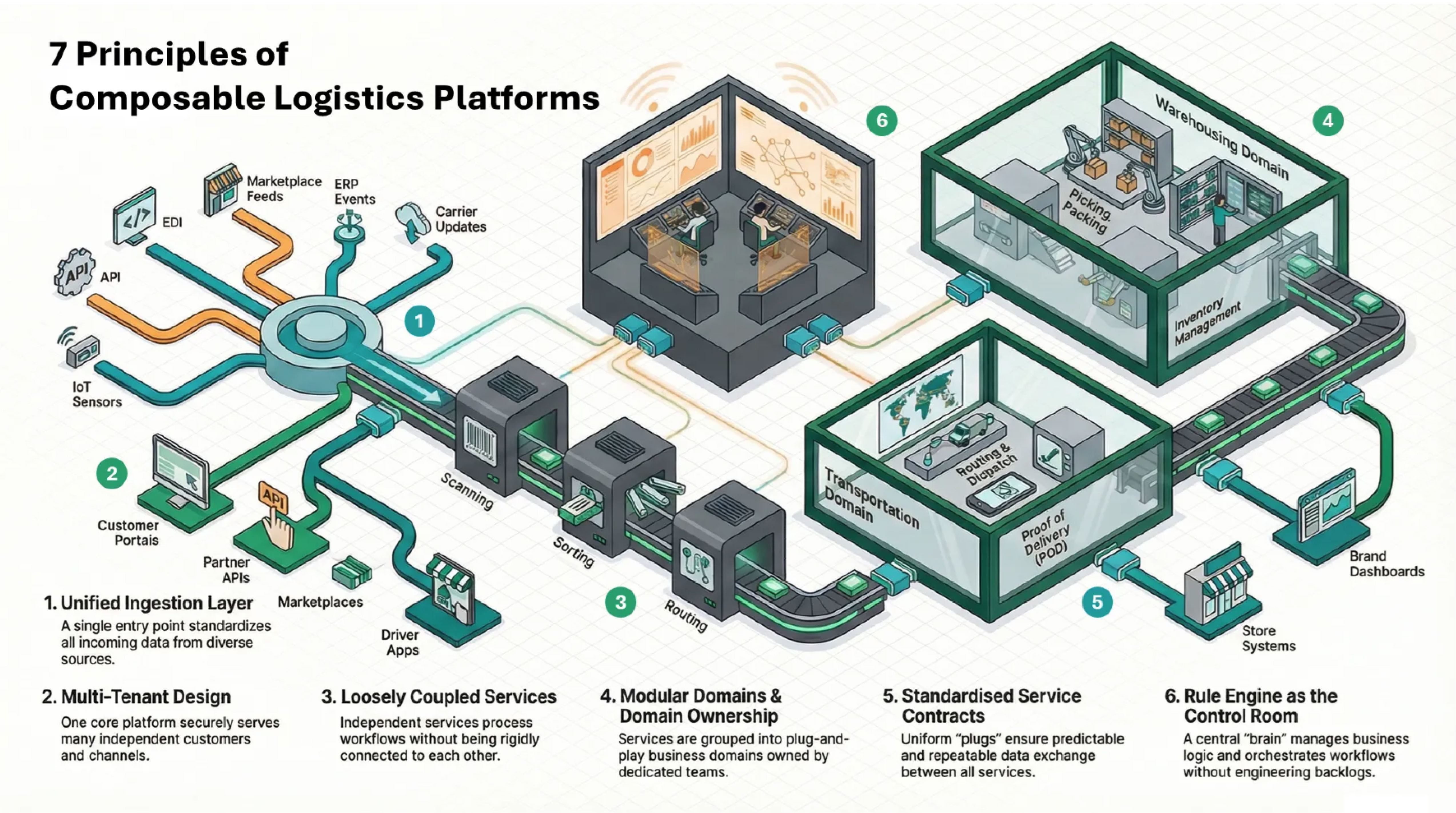
These principles represent the difference between a logistics technology function that enables growth and one that constrains it.
Legacy logistics IT landscapes are built around systems (WMS, TMS, OMS, ERP). Composable platforms are built around capabilities; smaller, reusable building blocks that support multiple services and customer journeys.
- Inventory availability
- SLA monitoring
- Rate & tariff calculation
- Order orchestration
- Billing triggers
- Label generation
- Partner connectivity
- Customer notifications
Why it matters: Capabilities can be reused across lines of business, enabling faster innovation and reducing reliance on monolithic vendor systems.
Executive impact: Less custom development, faster time-to-market, lower long-term cost.
In a composable platform, each capability should be independently deployable, testable, and changeable — without impacting others.
- Services expose clear interfaces
- They do not call each other directly
- They communicate through events or orchestrated flows
- Each service can evolve independently
Why it matters: Loosely coupled services prevent “platform gridlock,” where every change requires coordination across multiple systems or teams.
Executive impact: Higher delivery velocity, fewer release conflicts, and more resilient platform operations.
Logistics organizations integrate with a growing number of external systems:
- Marketplaces
- Retailers
- Vendor platforms
- Courier networks
- ERPs
- IoT sensors
- Customs systems
Without a unified ingestion layer, each integration becomes a bespoke, fragile project, inconsistent and expensive.
- One entry for all inbound data
- Format-agnostic transformation (API, XML, EDIFACT, JSON, CSV)
- Validation, mapping, enrichment
- Routing to the right internal services
- Full traceability
Why it matters: It allows onboarding a new customer, carrier, or partner in days, not months.
Executive impact: Consistent integrations, reduced project overhead, and materially lower TCO.
A logistics platform must support multiple customers with different:
- SLAs
- SOPs
- Billing models
- Cut-offs
- Routing rules
- Compliance requirements
- Shared core capabilities
- Strict data isolation
- Customer-specific configuration
- Seamless updates without environment duplication
- Predictable scaling
Why it matters: One platform can support many customers without multiplying systems or environments.
Executive impact: Lower operational overhead, simpler scaling, better commercial margins.
Every customer expects workflows that reflect their own way of operating. Hard-coding this logic is slow, expensive, and unsustainable.
- SLAs
- Routing preferences
- Notification triggers
- Carrier selection logic
- Exception flows
- Billing triggers
- Customer-specific workflows
All without engineering changes.
Why it matters: Customer onboarding becomes configuration, not development.
Executive impact: Accelerated sales cycles, faster customer ramp-up, and reduced tech backlog.
In a composable platform, integration shouldn’t require custom projects or bespoke data handling. Instead of multiple external interfaces, the platform uses one unified ingestion layer for everything coming in (Point 3), and standardized internal contracts for how services interact inside the platform.
- Exposes predictable inputs and outputs
- Follows consistent event formats and naming
- Uses idempotent operations
- Adheres to platform-wide schemas
- Is replaceable without altering upstream or downstream services
This lets the orchestrator, rule engine, and operational services “plug in” capabilities as interchangeable building blocks.
Why it matters: The platform becomes truly composable; new modules can be added or swapped without redesigning flows or creating one-off integrations.
Executive impact: Safer modernization, reduced vendor lock-in, and the long-term ability to evolve the platform with minimal technical friction.
Technology architecture does not exist in isolation; it reflects the structure of the organization that builds it.
“Any system will reflect the communication structures of the organization that built it.” — Conway’s Law
In logistics, this law has direct strategic implications, if teams are not aligned to core business domains, the platform will inevitably become fragmented, inconsistent, and slow to evolve.
Composable logistics platforms require clear domain boundaries and teams that own those domains end-to-end.
Domains in logistics naturally align to stable, repeatable business capabilities such as:
- Warehouse Operations
- Transportation
- Inventory & Availability
- Billing & Revenue
- Customer Engagement
- Partner Integrations
- Control Tower & Risk
- Data & Insights
- Platform Core (orchestration, rules, identity, tenancy)
- Its data
- Its APIs and internal contracts
- Its logic and workflows
- Its service modules
- Its roadmap
- Its operational KPIs
This prevents overlap, duplication, and architectural drift.
A modern logistics platform typically uses two complementary organizational lenses:
Teams that own specific capabilities used across all customers:
- Warehousing
- Transportation and Last Mile
- Billing
- Inventory
- Customer Communication
- Control Room functions
These are your core platform units, ensuring shared capabilities remain consistent and scalable.
Teams aligned to business verticals or product lines:
- eCommerce Fulfilment
- Quick Commerce
- B2B Distribution
- Horoeka
- Cross-Border
These vertical squads configure the platform using the domain capabilities, not rewriting them.
Why this matters: This model ensures differentiation where needed (front-end workflows, SLAs, customer nuance) while maintaining architectural consistency everywhere else.
Executive impact: A scalable organizational model that mirrors the platform architecture — essential for long-term growth.
Composable architecture generates value in five ways:
Rule engines + standard interfaces dramatically reduce onboarding time.
Less custom integration, fewer point solutions, and reusable capabilities.
New services can be introduced by assembling capabilities, not rebuilding workflows.
Legacy systems can be wrapped and gradually replaced without disrupting the platform.
Shared core + customer-specific configuration enables predictable expansion.
Together, these advantages transform a logistics platform from a collection of tools into a sustainable, competitive asset.
Event-Driven Architecture gives logistics platforms real-time reflexes. Composable architecture gives them structural agility.
Together, they form the foundation of a modern logistics platform, one capable of serving diverse customers, absorbing new business models, and evolving at the pace of the market.
In the next article, I will explore “How to Build a Multi-Tenant Logistics Platform, Lessons Learned”