المدونة
July 9, 2026
8
دقائق للقراءة
 التقارير والمقالاتالمدونةEverything You Need to Know About Car Transportation in Saudi Arabia and the Region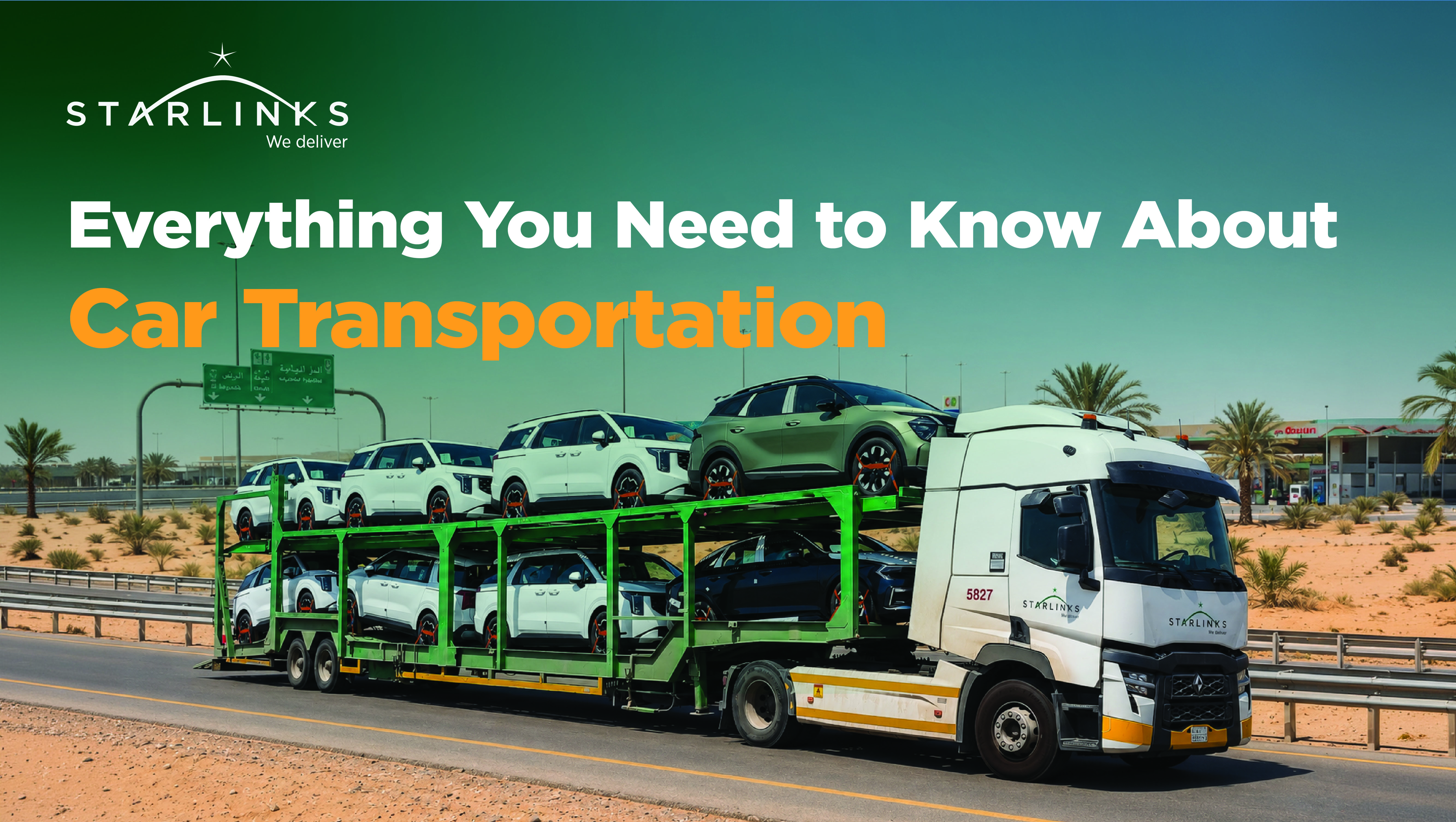
Every year, hundreds of thousands of vehicles arrive in Saudi Arabia and have to find their way to a showroom, a dealership, or a buyer. From the port where it lands to the showroom floor, and sometimes all the way to the customer, each one passes through a chain of carefully coordinated moves.
That's what car transportation really is. Not a truck and a destination, but a connected operation spanning ports, automotive yards, showrooms, borders, and buyers, each stage with its own risks, its own paperwork, and its own margin for error. Get it right and vehicles arrive on time, in perfect condition, ready to sell. Get it wrong and value leaks at every handover.
This article breaks down how car transportation actually works across Saudi Arabia and the wider region: the key routes, the different types of carriers, and how the current disruption at the Strait of Hormuz is reshaping the way vehicles reach the Kingdom.
Car transportation covers the full movement of vehicles from the moment they arrive in the country to the moment they reach their final destination. In practice, it serves a few key players: OEMs distributing new models nationwide, dealers replenishing showroom stock, importers bringing vehicles across borders, and owners of high-value or luxury cars who need specialist handling. What each of them needs is the same, vehicles that arrive on time, in perfect condition, with nothing lost along the way.
Transportation isn't one step in automotive logistics. It runs through the entire journey, connecting every stage from arrival to final delivery. And every one of those moves is a chance for something to go wrong: a scratch in transit, a delay that holds up a sale, a document that stalls a vehicle at the border. That is why transportation matters so much. It is not the simple part of the process, it is the thread that ties the whole chain together, and it decides whether a vehicle arrives ready to sell or arrives as a problem.
Car transportation in Saudi Arabia isn't a single trip from A to B. It's a series of distinct routes, each one a stage of the automotive logistics journey with its own purpose, timing, and coordination. Most vehicle movements follow a handful of well-defined paths.
The first mile is where the journey begins, moving vehicles from the factory to the origin port. This is the inland leg in the country of manufacture, getting finished vehicles from the production line to the RoRo vessel that will carry them abroad. It sets the pace for everything that follows: a delay here pushes back every stage down the line.
The middle mile is the long-haul leg that brings vehicles to where they need to be. It covers the movement from port to yard, whether that's a domestic route between cities inside the Kingdom or a cross-border land journey into neighboring markets. This is the backbone of car transportation, moving vehicles in volume from the point of arrival to the secure yards where they're stored, inspected, and prepared for sale. Reliability and coordination matter most here, because this is where the largest distances are covered.
The last mile is the final stretch, and usually the most visible. In most cases, it means moving vehicles from the yard to showrooms across different cities and locations, keeping dealerships stocked with the right models where demand is. In some cases it can also mean direct delivery from the yard to a customer's door, and occasionally a vehicle will go straight from the port to a showroom for urgent deliveries. Whatever the route, this is where first impressions are made, so vehicles need to arrive fully prepared and in showroom condition, which is the role of a capable automotive yard.
Not every vehicle can travel the same way. The right carrier depends on the type of car, its value, and the level of protection it needs, and choosing the wrong one can mean higher costs on one end or unnecessary risk on the other. A standard sedan moving in volume has very different requirements than a low-slung sports car or a high-value luxury model. Broadly, car transportation relies on three main carrier types.
Open carriers are the workhorse of vehicle distribution. They move multiple vehicles at once on an exposed multi-level trailer, typically carrying up to eight or ten cars depending on the model, which makes them the most cost-effective option for standard, high-volume movement between ports, yards, and dealerships across the Kingdom and cross-border. For smaller or more urgent needs, a flatbed truck covers single-vehicle moves, carrying just one or two cars when speed and flexibility matter more than volume.
.png)
Enclosed carriers put protection first. Inside a fully sealed trailer, the vehicle is shielded from weather, dust, and road debris, making this the standard choice for luxury models, premium imports, and any high-value unit where arriving in flawless condition is non-negotiable. In Saudi Arabia, they're typically used as a dedicated move for a single car, giving it a direct and controlled journey. When people talk about specialist transport for expensive cars, this is usually what they mean.
Low-bed and hydraulic carriers solve a physical problem: many luxury and sports cars sit too low to the ground for standard loading ramps. Their adjustable platforms lower to ground level, allowing these vehicles to be loaded and unloaded without any risk of scraping or damage. These carriers are usually enclosed, combining easy ground-level loading with full protection, which makes them the go-to choice for the most demanding, low-clearance vehicles, often as a dedicated move for a single high-value car.
Car transportation doesn't happen in ideal conditions. Right now, the region is facing one of the most significant maritime disruptions in years, and it's directly affecting how vehicles reach Saudi Arabia and the entire Gulf region.
As of April 2026, the Strait of Hormuz is experiencing unprecedented disruption due to regional conflict. Daily vessel traffic has collapsed from over 130 transits to fewer than 10. Nearly 400 ships remain bottlenecked in the region, and experts warn that clearing the backlog will take months even once conditions stabilize. The concern doesn't stop at Hormuz. Bab al-Mandab, the second critical gateway feeding Red Sea and Jeddah-bound traffic, sits under the same regional tension, and any disruption there would narrow the alternatives available to importers even further.
For vehicle imports, the impact is real: delayed arrivals, uncertain timelines, and inventory stranded far from the showrooms that need it.
Rather than wait for conditions to improve, Starlinks restructured its finished vehicle logistics network to keep vehicles moving.
Vehicles ship from origin points including Shanghai, Lianyungang, Fuzhou, Singapore, and Sri Lanka, routed to arrive at Jeddah as the primary gateway, completely bypassing the Strait of Hormuz. Sohar in Oman and Khor Fakkan in the UAE serve as secondary gateways, adding further flexibility when any single route comes under pressure.
The real advantage is what happens once vehicles land. From Jeddah, Starlinks' land transport network carries them onward across the Kingdom and out into the wider region, reaching the GCC markets of Kuwait, Bahrain, Qatar, the UAE, and Oman, as well as Iraq, Jordan, and Syria. This road connectivity is what turns a disrupted sea route into a workable end-to-end journey, moving vehicles from a single reliable port of entry to wherever they need to go. Combined with worldwide spot request handling and custom routing, it means vehicles keep arriving even while the disruption continues.
.jpg)
The message for importers is simple: while the region navigates uncertainty, vehicle imports keep moving reliably.
What makes all of this work isn't any single truck or route. It's an integrated network that treats car transportation as one continuous operation, from the moment a vehicle arrives by RoRo, through the yard, and on to the showroom or the customer.
This is where Starlinks' real strength lies: end to end automotive logistics with one partner. Rather than stitching together separate providers for each stage, brands get the full journey handled as a single, connected operation. That covers:
▪️RoRo Arrangements: port receiving and complete customs clearance.
▪️Car Transportation: a dedicated fleet across the Kingdom and the region.
▪️Automotive Yards: secure storage, inspection, and pre-delivery preparation.
▪️Spare Parts Logistics: integrated automotive parts handling and distribution.
Because these pieces run as one operation rather than being handed between separate providers, vehicles move through each stage without the gaps that usually appear where one service ends and another begins.

The transportation network reaches nationwide across the Kingdom and extends cross-border into the wider region, with the capacity to handle everything from high-volume vehicle movement to smaller, single-unit shipments. Throughout the journey, real-time visibility gives brands unit-level tracking of where their vehicles are and when they'll arrive. Damage-free handling, backed by AI-powered inspection at key handover points, protects vehicle value from arrival to final delivery. And because it all runs under one partner, one SLA, and one source of truth, there are none of the blind spots and finger-pointing that come from stitching together multiple vendors.
For OEMs, dealers, and importers moving vehicles across Saudi Arabia and the region, that's the difference between simply shipping cars and running a distribution network built to perform, even when conditions aren't.
Car transportation is rarely the part of automotive logistics that gets the most attention, but it's often where deals are won or lost. Vehicles that arrive on time, in perfect condition, and ready to sell start with a transportation network built to handle every route, every carrier type, and every disruption along the way. That's exactly what Starlinks was built to deliver.
Partner with Starlinks and move your vehicles through one connected automotive logistics network, from port to showroom, across Saudi Arabia and the region.